
A report this week from Olathe data analyst Earl Glynn reveals distinct connections between a dark money fund pushing to keep the state’s elitist method of selecting Supreme Court Justices to the funders who injected $23 million to keep Laura Kelly in the governor’s office in 2022.
A fundraising page for the Kansas Fair Court Fund identifies the Kansas Values Institute — a nonprofit that spent nearly $23 million during the 2022 Kansas elections, much of it on advertising supporting Democratic Gov. Laura Kelly and opposing Republican challenger Derek Schmidt — as the organization receiving the donations, according to Glynn’s research.
Glynn said the connection is not readily apparent on the Kansas Fair Court Fund’s public-facing website, but appears in the underlying donation page and its computer code.
“There is nothing obvious at first on the ‘Donate to Kansas Fair Court Fund’ page that suggests anything about where the money is going,” Glynn writes in his Watchdog Lab Substack. “However, clicking the X social-media icon at the bottom of the page directs users to an account associated with the Kansas Values Institute.”
Glynn also reviewed the source code for the fundraising page, hosted through the nonprofit donation platform Qgiv. He said “Kansas Values Institute” appears in three places within the page’s HTML code, including its header and banner information.
“So if Kansas Fair Courts Fund is not another project of Kansas Values Institute, why is their name on the donation page in three places?” Glynn asked.
The donation page is titled “Donate to the Kansas Fair Court Fund,” but Glynn said it identifies the Kansas Values Institute as the organization operating the fundraising account. He described that as the clearest evidence that the court campaign is being conducted through KVI’s fundraising structure.
Kansas Values Institute has also used the project name “Kansans for Fair Courts” since at least 2013, Glynn reported. He contends the similarly named Kansas Fair Court Fund appears to be a newer KVI project associated with the 2026 campaign on Kansas Supreme Court justice selection.
The Kansas system of judge selection has been criticized because of its lack of public input on those appoitnments. In Kansas the process is highly restrictive: The state’s selection committe includes one attorney chairperson elected statewide by Kansas lawyers. Four additional attorneys are elected by lawyers in each congressional district. Four non lawyers, one from each congressional district are appointed by the governor. This committee selects three candidates and the governor must choose one of those candidates.
Supporters say this arrangement insulates judges from partisan campaigns, campaign donations and pressure from legislators. Critics argue it gives the organized bar disproportionate power, limits the governor’s democratic accountability and allows a relatively small group of lawyers to determine which candidates the governor may consider.
Conservatibves have railed at what they term liberal rulings of the Kansas Clurt, but another issue appears to be rulings that don’t follow the U.S. Constitution. Of seven Kansas Supreme Court rulings reviewed by the SCOTUS since 2007, six were overturned. The constitutional amendment would allow Kansas voters to choose those replacements to the bench.
The Kansas Fair Court Fund has released advertising warning that wealthy interests could “buy” seats on the Kansas Supreme Court. Glynn argues that message is inconsistent with the Kansas Values Institute’s own extensive spending in the 2022 governor’s race.
“A recent video by the Kansas Fair Court Fund complains that billionaires would tear down fair courts and buy seats in the Supreme Court,” Glynn writes, “yet KVI saw nothing wrong with “buying” the Kansas governor in 2022 with $23 million. Hwe said Kansas Values Institute appears now to have set its sights on making sure Kansans can’t vote on Supreme Court judges,.
Kelly defeated Schmidt by approximately 22,000 votes in 2022. Glynn said KVI’s nearly $23 million in election-related spending was greater than the combined spending of the both the Democratic and Republican gubernatorial campaigns. He reported that one Washington, D.C.-based nonprofit supplied approximately $14 million of that money. Political advertisements financed by the Kansas Values Institute during the 2022 election can still be viewed through the Kansas Institute for Politics at Washburn University, which maintains an online archive of Kansas campaign advertising.
Glynn’s examination of KVI’s federal tax filings found that the organization raised nearly $43 million from 2011 through 2024 and spent approximately $42.5 million during that period. Although organized as a tax-exempt nonprofit describing itself as nonpartisan, KVI has been a significant financial participant in Kansas political and judicial-selection campaigns.
The organization’s 2025 financial information will not become publicly available until late 2026 at the earliest, Glynn noted, leaving the amount it may spend on the 2026 judicial campaign unknown.
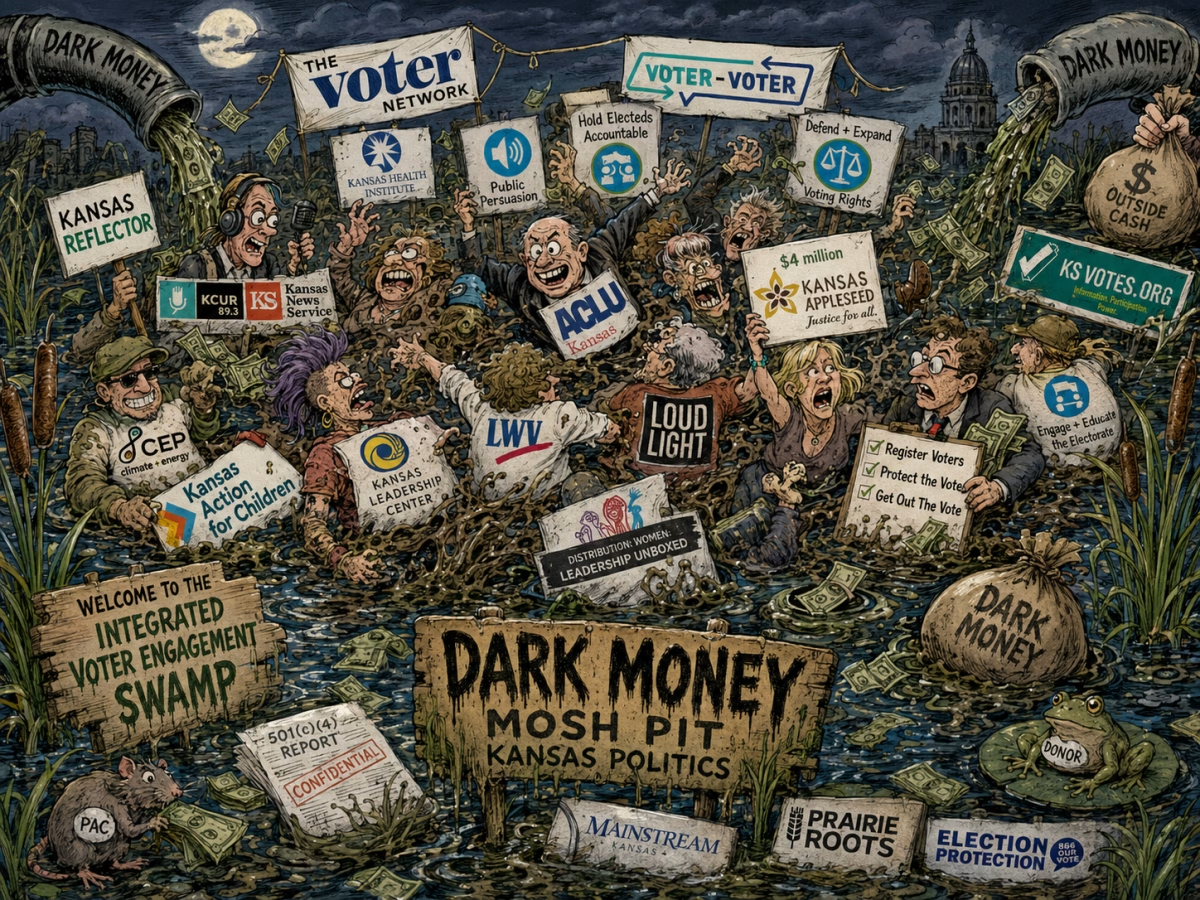
“Nonprofit and other dark money has been buying Kansas elections for years,” Glynn wrote. “Voters need to wake up to what nonprofits are doing in elections.”
Glynn also pointed to Kansas United for Impartial Courts, a coalition opposing a proposed constitutional change in the judge selection method. He said nonprofit organizations participating in that campaign have created staff positions paying between $8,000 and $12,000 per month to help defeat the amendment.