“Old hands” on the political stage in Friday afternoons Kansas Republican Governor’s race debate traded barbs with political newcomers, with both camps agreeing on much but differing on the value or liability of being a “career politician.”
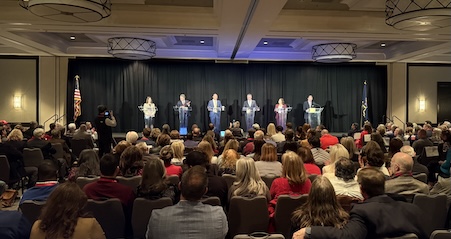
Those seeking the GOP gubernatorial nomination got their first appearance before a mixed audience, sharing the stage with other contenders at Friday’s Kansas Republican Party Winter Convention in Wichita. The gathering drew more than 600 attendees from across the state and packed the Wichita Marriott main ballroom.

Candidates Charlotte O’Hara, Jeff Colyer, Scott Schwab, Ty Masterson, Joy Eakins and Phillip Sarnecki delivered on a repeated mantra of career politicking along with topics of Kansas Star Bonds and corporate welfare, judicial selection, Governor Kelly’s refusal to provide SNAP data to USDA, education, marijuana, abortion, ICE protests and immigration, positions on alternative energy, all posed by KQAM’s Andy Hooser.
The defining point of the evening seemed to be who had the benefit of experience serving in office and who carried no baggage as new blood. O’Hara opened her remarks attacking Secretary of State Schwab over allegations of ballot destruction in Johnson County during the 2020 election, a charge Schwab has repeatedly countered, saying county officials destroyed the ballots after the legal retention period expired. It was the first of barbs from O’Hara, Eakins and Sarneckie aimed at Colyer, Schawb and Masterson over having been tainted during their terms of service with failures in office.

“That type of thing is why we lose – in the general election particularly,” Masterson said. “What was the Reagan quote about 80 percent my friend not 20 percent my enemy? We spend time cutting each other off at the legs. This is not the enemy. The Democrats are the enemy.”
Schwab, with seven years as secretary of state, said experience wasn’t synonymous with baggage. “Having experience to understand the terrain has always been a plus in America, Having experience helps. It’s called learning.”

Masterson, President of the Kansas Senate, sold himself as a ‘battle tested, proven leader’ with successes thwarting Laura Kelly’s agenda, protecting women’s sports, making Kansas a constitutional right to carry state, banned DEI in higher education and the executive branch, simplified the income tax and taking the estate tax off property. ‘Ultimately what I’ve learned Is that as a legislator the sword I yield is just not powerful enough to slay the dragon of government overreach if we have a Democrat machine in the office.”
Eakins, owner of a data consulting firm, laid hard on the newcomer pitch as well, saying “Career politicians have been steering our decline” in Kansas, creating a state where residents are leaving for better opportunities and where “we’re paying more than we ever have for education but our kids aren’t getting one.”
On property taxes and a constitutional amendment capping property tax valuations at 3 percent each year, Colyer said taxes are high because spending is high – up 60 percent since he was governor. He supported the constitutional amendment to control property taxes. He said spending had to be controlled.
“Here’s what we did: We eliminated 5,500 unnecessary state employees, and nobody noticed.” He also touted the privatization of Medicaid, which he said saved over a billion dollars a year for the past 15 years.

Schwab said developers community champions were concerned about taxes but also concerned about putting anti-free market principles into law. He said caps could be inequitable between properties of different values. He said property tax discussions should also be a focus on local school districts and county commissions. “It has to be free market,” Schwab said.
O’Hara said she was releasing a property tax reform plan at the convention that was more beneficial than a 3 percent cap, and allowed for regional tweaking. Sarnecki pointed again to a failure of career politicians. ”The property tax situation we’re in right now is not a problem in every state – it is a problem in Kansas,” Sarnecki said.
Tax discussions brought up Sals Tax And Revenue (STAR) bonds. Schwab noted incentive tools aided growth like the development in western Wyandotte County and the fact that the area had elected its Republican legislator since the 1980s. “If we do good growth, we end up getting good value, because we get the smart people.”
Masterson said false information had permeated the Chief’s stadium STAR bonds discussion, which offered growth, jobs and careers. “The state doesn’t have to raise a single tax,” Masterson said. “I want things built in Kansas.” He said income tax estimates were over $3 billion over the term of the bonds, and that meant revenue for the state of Kansas.

Eakins opposed the Chief’s deal, saying things went bad when the government picks winners and losers with incentive deals. Sarnecki said incentives like the Panasonic deal weren’t successful, because tax costs were still high. “Is it working?” Sarnecki asked. “Your property taxes are 50 percent higher per capita on average than every state in our region. Your income tax is the highest in the region.”
O’Hara called Kansas corporate welfare “an absolute graveyard of disastrous results,” noting the loss of Boeing, Cerner, and incentives to rich companies like Panasonic and the Hunt family. “We have giving up on the free market, and do you know why? Because Kansas is the high tax point on the prairie,” she said.
Colyer called STAR bonds were a tool that had to be used sparingly, and he would not back the state standing behind delinquent bonds in a deal gone bad. He said a lower tax and regulation environment and reduction of state overhead was preferable to incentive deals.
The chorus of candidates expressed uniform suspicion at Laura Kelly’s denial of Kansas SNAP data to the USDA in its national audit of the program. They also all supported the upcoming August constitutional amendment vote to elect the Kansas’ Supreme Court justices. Sarnecki said judges should also declare their party affiliation on the ballot. Masterson said the justice election vote was indeed more important than the governor’s race.
Schwab landed the biggest round of applause on the education topic, heaping much of the issue of underperformance in Kansas public schools and the growth in popularity for school choice on the Kansas National Education Association. “The best thing we can do for K-12 is just get rid of the KNEA,” Schwab said, saying the teachers’ union muddled performance and raised costs, “and the K-12 mission creep is toxic.” Eakins said there had been a lot of talk about school choice, but leadership had not gotten it done.

Marijuana legalization got low marks from the office seekers because of a lack of credible research and financial and social challenges in states that had legalized either medical or recreational pot.
The candidates embraced a firm pro-life agenda and opposition to the Kansas Supreme Court constitutional decision. O’Hara quoted figures of nearly 20,000 abortions in the state in 2024, 35 of which were to girls between the ages of 10-14, yet none were reported as abuse to authorities. “Every abortion on a girl under 16 has to be reported (to police) because at a minimum it’s statutory rape,” she said.
There was no argument regarding support for ICE and the mission of the Trump Administration to deport criminal migrants. There was also uniform support for energy industry expansion in the state, without tax credits and abatements
The deadline for official filing in the governor’s race is June 1. Future debates could be arranged either before or after the filing date through the spring and summer if campaigns agree on it. The primary election is set for August 4.

Dane Hicks is a graduate of the University of Missouri School of Journalism and the United States Marine Corps Officer Candidate School at Quantico, VA. He is the author of novels "The Skinning Tree" and "A Whisper For Help." As publisher of the Anderson County Review in Garnett, KS., he is a recipient of the Kansas Press Association's Boyd Community Service Award as well as more than 60 awards for excellence in news, editorial and photography.