
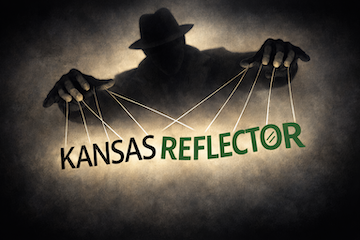
The Kansas Reflector’s Clay Wirestone’s attempt to caricature Senate President Ty Masterson says far more about the Reflector than it does about Masterson.
Rather than addressing the substance of Masterson’s critique, the editorial relies on mockery and metaphor, comparing him to a “raccoon who drank a bunch of liquor and passed out on a bathroom floor” and as “the Ashland, Virginia mammal.”
Satire has a long and storied history in American commentary. This was not satire; it was juvenile rhetoric. An opinion page should model clarity, restraint, and intellectual seriousness, especially in a time of heightened political division. When Wirestone replaces analysis with crude metaphors involving animals and intoxication, he abandons the very standards that separate opinion journalism from social-media snark. Kansans deserve better, particularly from an outlet that presents itself as a “neutral watchdog.”
Facts will guide this response, not childish theatrics.
1. Criticism of the Reflector isn’t “conspiracy,” it’s accountability.
Senate President Masterson raised concerns that the Kansas Reflector regularly frames policy and politics through a distinctly progressive lens. Whether one agrees or disagrees, that is a legitimate topic for public debate. When public officials question a media outlet’s posture, the response should be transparency and thoughtful engagement, not puerile insults.
Journalists rightly hold public officials accountable. That principle cuts both ways. Accountability does not become “conspiracy” simply because the questions are uncomfortable.
2. The funding question is fair and the Reflector dodges it.
The Kansas Reflector insists it is not “Soros-funded,” but that talking point sidesteps the larger and more reasonable question: Where does its funding come from? The Kansas Reflector is not a standalone, independently financed local publication. It is a state affiliate of States Newsroom, a nonprofit 501(c)(3) umbrella organization that raises funds through a mix of foundation grants and individual donations. States Newsroom provides centralized operational support for 39 state-branded news sites, including the Kansas Reflector.
In practical terms, the Kansas Reflector is funded through States Newsroom’s national nonprofit model, not through a separate, Kansas-only revenue stream. Its financial base flows through the network’s centralized fundraising and support structure. Since becoming a nationwide operation, States Newsroom’s model has been to build state-branded outlets with shared infrastructure, fundraising, and content syndication.
When Masterson and other elected officials point out that the Kansas Reflector is part of a coordinated national network, they are simply describing what States Newsroom itself says on its website. If the Reflector wants Kansans to judge the “local” character of the project, the public should at least be told plainly that they are looking at a large, professionally run national network operating dozens of state sites under one umbrella. For the record, here are the 39 state affiliates States Newsroom lists as part of its network and “partners” in all 50 state capitals:
States Newsroom does not publish a neat “top donors with dollar amounts” table on its public Supporters page. However, it does disclose the names of contributors above its reporting threshold, and those disclosures show a mix of national foundations, community foundations, donor-advised funds, and institutional supporters.
In addition to those name-only disclosures, several major contributions have been publicly reported with specific dollar figures. For example, The Pew Charitable Trusts announced it would transfer its Stateline news service to States Newsroom and provide a $3 million grant to support that transition. The Wyss Foundation likewise lists a major grant to States Newsroom in its publicly available grants database totaling $1,140,000. Beyond these quantified grants, States Newsroom’s disclosed donors list includes the Rockefeller Family Fund, Rose Community Foundation, and the Google News Journalism Emergency Relief Fund, among many others. Taken together, these disclosures reflect a national funding base rather than a locally financed Kansas-only operation.
Transparency matters. Asking who funds an outlet that claims nonpartisan credibility is not an attack; it is a basic and reasonable question in a democratic society. Readers are encouraged to review the organization’s own materials:

3. The Reflector blurs the line between news and opinion, then pretends it doesn’t.
The Reflector argues that Masterson quoted an opinion writer, not “the whole publication.” But the Kansas Reflector operates under a single banner, platform, and brand. When commentary repeatedly frames conservatives as reckless and sinister, readers naturally infer that this reflects the outlet’s broader editorial culture. You don’t get to publish inflammatory commentary year-round and then cleanse the institutional brand by saying, “that was just one person.” The Reflector regularly preaches accountability, except when that accountability is applied to itself.
This concern becomes more significant given the organization’s legal and funding structure. States Newsroom operates as a 501(c)(3) charitable nonprofit and promotes itself as providing “nonpartisan” journalism. That tax-exempt status was approved in July 2019. Prior to that, States Newsroom operated with the Hopewell Fund as a fiscal sponsor and incubator, meaning Hopewell handled administrative and compliance functions while the project ramped up. That history matters because a 501(c)(3) organization is barred from political campaign activity and tightly limited in lobbying. The entire premise of the charitable newsroom model rests on public trust that the organization is providing a neutral public service, not partisan political advocacy. By contrast, a 501(c)(4) social-welfare organization can engage in substantially more lobbying and limited political activity.
4. Following the money.
States Newsroom’s own supporter disclosures show that its funding ecosystem is not limited to traditional 501(c)(3) charitable foundations, but also includes organizations organized under other sections of the tax code that are explicitly advocacy oriented. Among the contributors that can be confirmed as 501(c)(4) “social welfare” organizations are North Fund, Vote Run Lead Action, and the League of Nebraska Municipalities, all of which are permitted to engage in policy advocacy and political activity consistent with their missions. These are not neutral public-education charities; they exist to influence public policy and civic outcomes.
In addition, States Newsroom’s supporter lists have included organizations operating under 501(c)(5) and 501(c)(6) classifications, which are likewise advocacy-based by design. For example, AFSCME, a major public-sector labor union, is a 501(c)(5) organization created to advance the interests of its members, while municipal leagues and similar associations commonly operate as 501(c)(6) business or professional leagues advocating on behalf of their constituencies. While it may be legal for a 501(c)(3) newsroom to accept support from such entities, the presence of (c)(4), (c)(5), and (c)(6) donors alongside charitable funders reinforces a legitimate concern: that States Newsroom and its state affiliates, including the Kansas Reflector, operate within a broader advocacy ecosystem rather than a strictly neutral charitable one, precisely the distinction the tax code is meant to preserve.
5. Advocacy, by any other name?
The real question, then, is not which box is checked on an IRS form, but whether the Kansas Reflector in practice operates like a neutral charitable newsroom or like an advocacy outlet shaping political outcomes. If an outlet’s consistent framing, editorial posture, and strategic emphasis resemble activism by another name, it is fair to ask whether a 501(c)(4) structure would be a more honest fit for the Reflector than a 501(c)(3) label that depends on nonpartisan credibility.
Kansas voters can decide for themselves what they think of that. But they should be clear-eyed about what the Kansas Reflector is: not a lone local paper, but a state-branded outlet inside a national network, financed by national donors, operating under a legal structure that carries public expectations of nonpartisan restraint.
Conclusion
Ty Masterson did not “smear” the Kansas Reflector by questioning its funding structure and ideological posture. He did what citizens and public officials should do: ask hard questions about influential institutions that shape public opinion.
If the Kansas Reflector wants public trust, the path forward is transparency and engagement, not mockery and name-calling.

Jay Vanier
Jay Vanier is a Salina, Kansas based entrepreneur focused on developing and commercializing advanced water-treatment technologies. His work centers on innovative systems designed to address PFAS, heavy metals, and other contaminants affecting municipal and industrial water supplies. He graduated from Kansas State University with a degree in Journalism and Mass Communications and earned his Juris Doctor (JD) from Washburn University School of Law.