


OSAWATOMIE — While commissioners leading Kansas’ towns and counties grapple with another budget season chasing dollars for next year and anticipate tax payer blowback from spending plans that pass the “revenue neutral” tax threshold, a proposed multi-billion-dollar data center campus in Osawatomie could generate more than $30 million annually once complete – washing away city debt and making property taxes for city homeowners virtually a thing of the past.
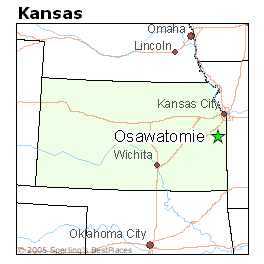
The proposed campus, known as Project Catalyst, would be developed by Kansas-based Alcove Development and MDH Partners of Atlanta. The current concept covers 283 acres near 335th Street and Osawatomie Road and could eventually include as many as seven buildings totaling approximately 3.3 million square feet. The campus would be constructed in phases and could ultimately require more than 500 megawatts of electric capacity.
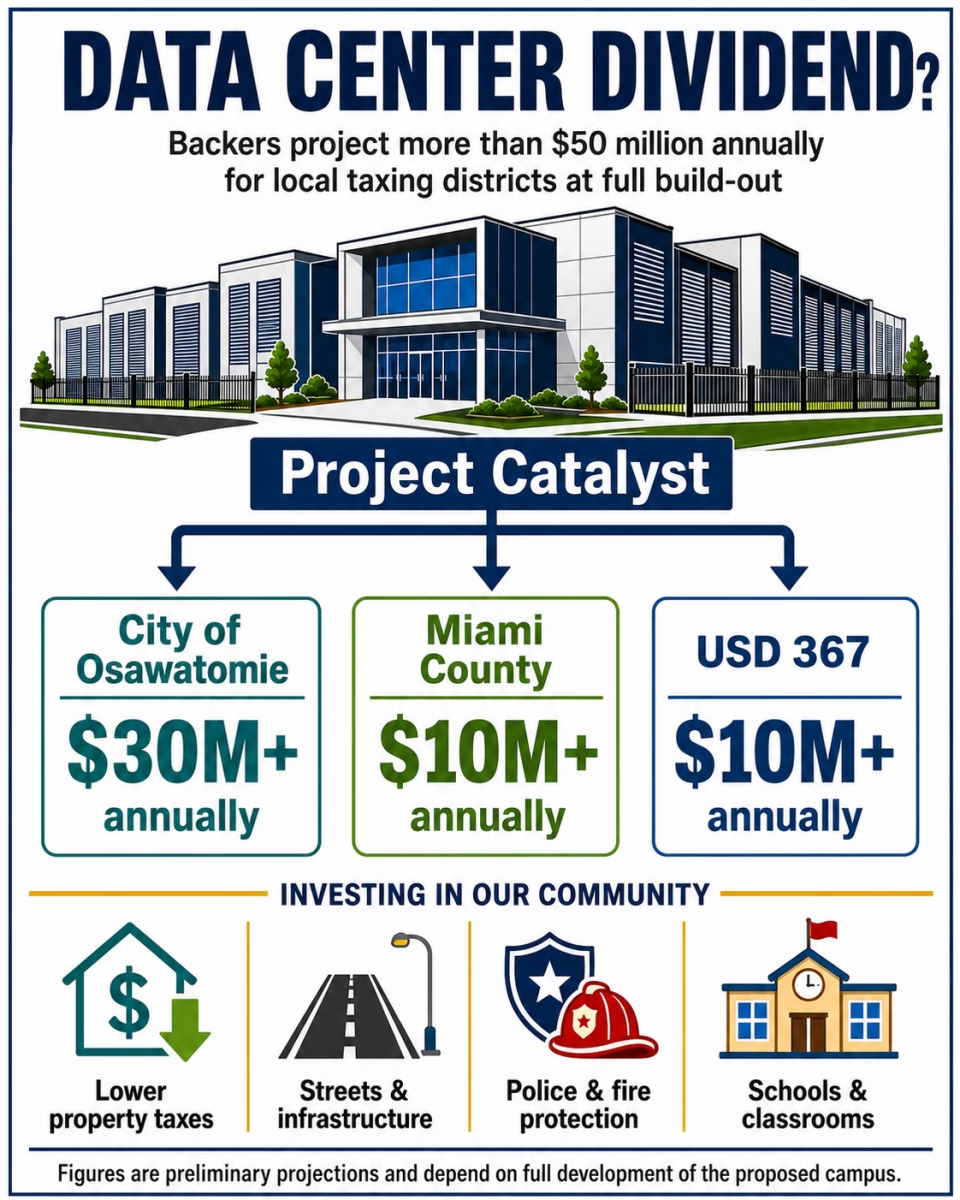
The largest share would go to the City of Osawatomie. A preliminary fiscal-impact analysis projects more than $30 million per year for the city through property taxes, electric franchise fees and other local revenues. Miami County and USD 367 would each receive more than $10 million annually as well in new property-tax revenue, according to a May 29 joint release from the city and Alcove Development.
By comparison, the entire Osawatomie city budget is $18.3 million for 2026.
If completed, the data center project is sure to be nothing less than transformative for Osawatome and Miami County. The Kansas City Business Journal has reported that the development team estimates the full project could represent approximately $10 billion in investment, create 2,500 construction jobs during the build-out and support about 100 permanent data center positions after completion. The project’s official website uses more general language, promising billions of dollars in investment, hundreds of construction jobs and permanent skilled positions in technology, operations and facility management.
GW Weld, principal at Alcove Development, said in the May announcement that “Project Catalyst has the potential to reshape the economic future of this community for generations to come.”
For Osawatomie and for other towns considering data centers as an economic development possibility, the project’s most significant potential benefit is a major change in the composition of the city’s tax base. City officials say nearly 80% of Osawatomie’s property-tax revenue currently comes from residential property, leaving homeowners to carry much of the cost of city services.
Earlier in the evaluation process, the city estimated that Osawatomie had approximately $42 million in total assessed valuation. City officials calculated that reducing the city mill levy by 20% without cutting existing services would require roughly $10 million in additional assessed valuation, equivalent to at least $40 million in new commercial appraised value under Kansas assessment rates.
City Manager Bret Glendening told KSHB 41 in a February interview, “Our goal here is not only to bring a significant commercial development to our community, but also to increase our tax base that isn’t residential.”

The projected $30 million in annual city revenue would potentially exceed Osawatomie’s current general fund many times over, according to the Project Catalyst website. City and developer communications say the money could be used for street maintenance, police and fire protection, parks, infrastructure, debt reduction and other community improvements.
Mayor Nick Hampson said during a June interview with KSHB 41 that the development “has potential for really good tax relief.” He added, “I would like to see debt reduction for our city.”
Glendening has said the mayor and City Council want to reduce taxes significantly and that he would work to prepare a budget containing tax reductions during the first budget cycle in which the city begins receiving project revenue. He also cautioned that Osawatomie cannot determine what Miami County commissioners or the USD 367 Board of Education would do with their respective mill levies.
For Miami County, the developers project more than $10 million per year in property-tax revenue at full development. Project communications describe that revenue as a substantial new foundation for county services. Depending on future decisions by county commissioners, such growth could provide additional money for roads, law enforcement, emergency services and other county operations, allow reductions in the county mill levy, or produce some combination of improved services and tax relief. The county has not made a public commitment regarding how it would use the projected revenue.
USD 367 would also receive more than $10 million annually in projected property-tax revenue. The city and developers say that money could provide recurring support for classrooms, teachers and students while producing little corresponding increase in enrollment because data centers employ relatively few permanent workers compared with residential developments of similar taxable value.
The project’s backers contend that the campus would produce unusually high revenue compared with the public services it requires. The official Project Catalyst website claims the development would pay approximately $15 in taxes for every $1 in municipal services it consumes. Developers say a data center would place less demand than a major residential or retail development on schools, traffic, roads, police and fire services.
The development team has also said the project would pay for the electric infrastructure needed to serve it. The May 29 release states that new transmission lines, substation upgrades and any additional generation capacity required for the campus would be funded by the project rather than existing Osawatomie residents or Evergy customers.
Project officials say the buildings would use air-cooled technology rather than traditional evaporative cooling towers. They maintain that, after the initial filling of a closed-loop system, daily water consumption would be largely limited to restrooms and hand-washing, comparable with the use of a conventional office building.
The revenue figures remain projections rather than guaranteed payments. They assume that the campus reaches full build-out, and the project website states that all estimates are preliminary and subject to change. Construction could begin as early as 2028, with tax revenue gradually increasing as individual buildings are completed and placed into operation.
No construction or final project plan has yet been approved. Hampson told KSHB 41 that continuing the process means negotiating the city’s financial benefits and addressing noise, water use, tax incentives and other potential impacts — not that the data center is already a completed deal.
Should the campus be completed substantially as proposed, however, its backers contend that Project Catalyst would give Osawatomie, Miami County and USD 367 a large commercial tax base without the population growth and service demands normally required to generate comparable revenue.
For Osawatomie residents in particular, the project’s promised benefit is straightforward: shift more of the cost of local government away from homeowners and onto one of the largest commercial developments ever proposed in Miami County.