
TOPEKA – Kansas has more than 273,000 registered voters listed as “inactive,” a record-high figure that raises fresh questions about voter-roll accuracy, county-level list maintenance and the potential election-integrity risks of keeping large numbers of questionable-address registrations on the books.
A new analysis by Kansas election researcher Earl Glynn found that the state’s May 4 voter file included slightly more than 2 million registered voters, with 273,413 marked inactive — about 13.6 percent of the statewide file. Glynn wrote that it was the highest number of inactive Kansas voters found in 47 voter files he reviewed over the past 20 years.
The finding does not mean those voters are illegal voters, nor does it prove fraudulent ballots have been cast. But it does point to a large pool of registrations tied to addresses that election officials have reason to question — a concern for those who argue accurate voter rolls are a basic safeguard for election integrity.
Under the federal National Voter Registration Act, commonly known as the “motor voter” law, states must follow specific procedures before removing voters from the rolls. The U.S. Department of Justice says the NVRA governs registration and list-maintenance requirements for federal elections, while the U.S. Election Assistance Commission says voter-list maintenance is the process election officials use to keep registration databases “accurate and up-to-date.”
Glynn’s report describes inactive voters as registrations for which mail could not be delivered to the listed address. He argued the public should understand inactive status as an “invalid address” warning, not merely a bureaucratic label.
That distinction matters because an inactive voter generally remains registered and may still be able to vote after updating or affirming address information, depending on the circumstances. Federal law also slows removals: voters usually must be placed in inactive status and then fail to vote in two federal election cycles before being removed through the normal address-confirmation process. That system is designed to prevent eligible voters from being wrongly purged, but it also means outdated registrations can remain on the rolls for years.
Glynn called the record-high inactive count “probably a good thing” in one respect, because voters must first be identified as inactive before they can eventually be removed if they do not respond or vote.
Still, the scale of the number is significant. The National Conference of State Legislatures says accurate registration lists help protect against fraud, help election officials plan for ballots, machines and poll workers, reduce wait times and simplify postelection procedures by reducing provisional ballots.
The Kansas data also show major differences among counties. Glynn found two counties with inactive rates above 30 percent: Seward County at 35.18 percent and Ford County at 31.42 percent. Three others — Finney, Labette and Linn — exceeded 25 percent. At the other end of the scale, Wilson, Hamilton, Logan, Stanton and Ellsworth counties were reported below 1 percent.
Those sharp differences raise a second issue: whether Kansas counties are applying voter-list maintenance in a consistent way. Glynn wrote that some counties’ inactive rates appear to change little over time, which he said may suggest “little or no list maintenance,” while other counties show much more movement.
The report also notes that inactive rates can be especially high in precincts with transient populations, including college campuses and military communities. Glynn cited one Lawrence precinct near the University of Kansas campus with an inactive rate of 67.21 percent, and listed other high-inactive precincts near Fort Riley and Fort Leavenworth.
Kansas has made more voter-registration data available in recent years. Glynn noted that a 2021 state law, K.S.A. 25-2361, requires the Kansas Secretary of State to publish monthly registration statistics, including inactive voter data. The Secretary of State’s office maintains a voter-registration statistics dashboard and monthly county-level data online.
Nationally, voter-roll maintenance has become a flashpoint between election-security advocates and voting-rights groups. The Associated Press reported this week that a Trump administration-backed eligibility-checking effort using the federal SAVE system has reviewed more than 67 million voter registrations, flagging about 24,000 as potential noncitizens and 384,000 as possibly deceased, while critics warned about false positives and improper removals.
Worst case, inactive registrations could become an election integrity problem if someone else is able to exploit those stale records before election officials remove them. A worst-case fraud pathway would look something like this:
First, a voter moves away, dies, registers elsewhere or stops receiving mail at the Kansas address. Mail from election officials is returned, so the voter is marked inactive, but federal law generally prevents immediate removal. The U.S. Justice Department says the National Voter Registration Act requires states to maintain accurate lists while also limiting how voters may be removed.
Second, the inactive registration remains on the books through the waiting period required by law. NVRA governs voter-list maintenance and also restricts systematic removals close to federal elections. That means a stale registration may remain visible in the system even when the person is no longer at the listed address.
Third, a bad actor would have to identify those inactive names and exploit a weakness in the voting process — for example, by attempting to request or intercept a mail ballot, falsely affirm an address, vote in the name of a person who moved away, or take advantage of loose address-confirmation procedures. That is the election-integrity concern: the larger the pool of stale registrations, the larger the theoretical target.
But the scheme would only succeed if ordinary safeguards failed. Those safeguards may include signature checks, ID requirements, ballot-tracking records, voter-history records, provisional-ballot review, address confirmation, death-record matching and duplicate-registration checks. And obviously there are criminal penalties for false voting.
There is a competing risk, too. Voting-rights groups warn that overly aggressive purges can wrongly remove eligible voters, especially people who move often, students, renters, military families and lower-income voters. The Brennan Center notes that purge errors can leave eligible voters without expected absentee ballots or unable to cast regular ballots on Election Day.
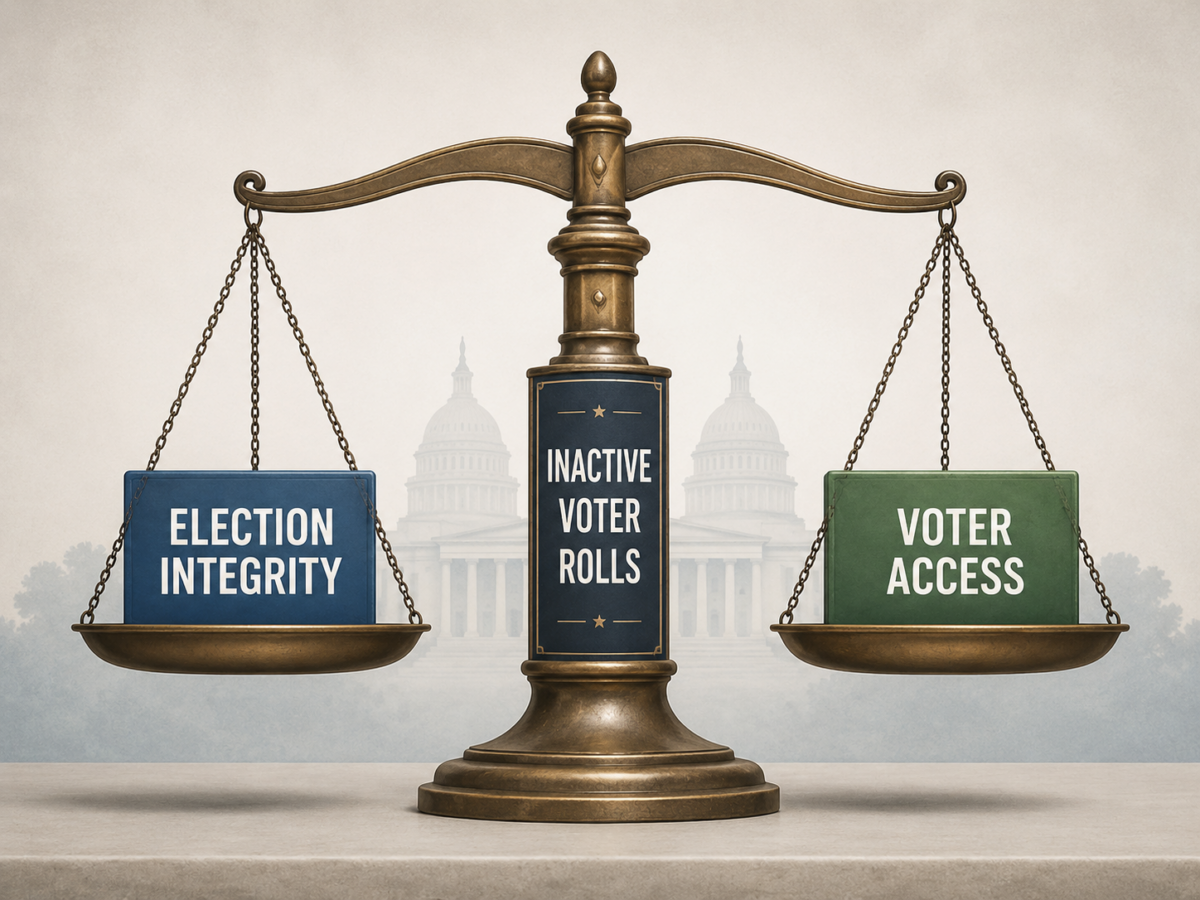
The Kansas numbers land in the middle of that debate. On one hand, a voter file with more than a quarter-million inactive registrations creates real administrative and election-integrity concerns, especially if old addresses, duplicate records or outdated registrations are not resolved promptly. On the other hand, federal law intentionally makes removal slow because erroneous purges can disenfranchise eligible voters who moved, missed mail or failed to update paperwork.
Glynn’s analysis shows Kansas appears to be doing more to identify questionable-address registrations, but the size of the inactive list — and the wide county-to-county variation — suggests list maintenance remains uneven and politically sensitive.