


TOPEKA — Tuesday’s sharp stock-market rally may have added approximately $177 million to $179 million to the Kansas Public Employees Retirement System’s domestic-stock holdings, based on the market’s final closing numbers and KPERS’ latest investment report.
At the 3 p.m. Central close Tuesday, the Dow Jones Industrial Average had gained 998.40 points, or 1.88%, to finish at 54,175.70. The broader S&P 500 rose 144.39 points, or 1.90%, to 7,744.97, while the Nasdaq composite climbed 697.17 points, or 2.69%, to 26,610.62, Reuters reported.
The rally was driven partly by strong corporate earnings from companies connected to artificial intelligence and data-center construction. Caterpillar gained about 6% after raising its revenue-growth forecast, while Palantir Technologies climbed nearly 30%.

“The earnings reports were certainly supportive,” investment strategist Jack Ablin told Reuters. Falling oil prices and optimism over diplomatic efforts involving Iran also contributed to the market’s rise.
KPERS’ latest actuarial valuation reported $30.893 billion in total market assets as of Dec. 31, 2025. Of that amount, approximately $9.404 billion, or 30.4%, was invested in domestic equities. The remainder was invested in international stocks, fixed-income securities, real estate, alternative investments and cash.
The report describes the market value as the fund’s current “snapshot” or “cash-out” value at the time of the valuation.
Applying the Dow’s final 1.88% increase to the $9.404 billion domestic-equity portfolio produces an estimated gain of approximately $176.8 million.
Using the broader S&P 500’s 1.90% increase produces an estimated gain of approximately $178.7 million.
That places the most reasonable estimate at about $177 million to $179 million, assuming KPERS’ domestic-stock investments generally moved with the overall U.S. market Tuesday.
The figure remains an estimate rather than an official KPERS daily return. The system does not invest exclusively in the 30 companies included in the Dow or precisely mirror the S&P 500. Its actual domestic-stock holdings also may have changed since the Dec. 31 valuation.
More workers paying in than retirees drawing out
The investment gain is significant because the KPERS trust fund supports retirement benefits for a large and growing population of current and former public employees.
As of Dec. 31, 2025, KPERS had 156,554 active members participating in its retirement plans, an increase of 866 from the previous year. That included:
- 21,138 state employees;
- 87,875 school employees;
- 38,306 local government employees;
- 8,951 police and fire members; and
- 284 judges.
“The total number of active members in KPERS increased from the prior valuation for all groups,” the actuarial report states.
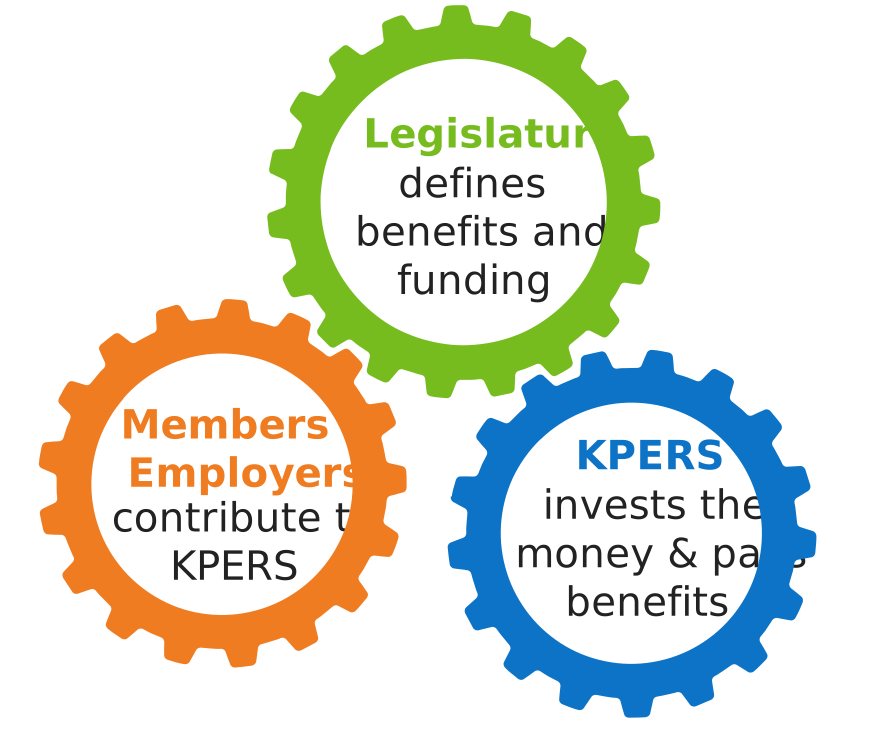
Most KPERS state, school, local government and judicial members contribute 6% of each paycheck to the retirement system. Police and fire members contribute 7.15%. Employers also make contributions based on payroll and actuarially determined rates.
“Both active members and employers contribute to KPERS,” the system’s employer manual explains. Contributions are made from gross pay during each pay period.
On the other side of the system, KPERS reported 110,083 retired members receiving benefits at the end of 2025. Another 9,747 beneficiaries, generally surviving spouses or other eligible recipients, also received payments.
That brought the total number of retired members and beneficiaries drawing money from the system to 119,830, up 1.7% from the previous year. There were about 1.3 active contributing members for every retiree or beneficiary receiving payments.
KPERS reported projected annual retirement payments of approximately $2.181 billion to those retirees and beneficiaries. The average annual benefit among retirees and beneficiaries was about $18,202, although individual benefits vary considerably depending on salary, years of service and retirement plan.
Investments help bridge the difference
During 2025, KPERS received approximately $569.2 million in employee contributions and $1.163 billion in statutory employer contributions. After service purchases and miscellaneous contributions were included, total contributions reached approximately $1.737 billion.
The system paid approximately $2.420 billion in total benefits during the year, including regular retirement benefits, partial lump-sum payments, withdrawals and death benefits. Investment income totaled approximately $3.587 billion, helping the fund finish the year with a net increase in assets.
KPERS describes the system as prefunded rather than a program in which today’s employee contributions are simply transferred directly to today’s retirees.
“The KPERS Trust Fund is made up of contributions and investment income,” the agency explains. It also notes that, over time, investments have paid for about half of member benefits.
That makes investment performance an important part of the system’s long-term financial health. Tuesday’s estimated $178 million domestic-stock gain would equal roughly one month of the system’s projected retirement payments, although future market losses could reverse some or all of that increase.