

Across Kansas and the rural Midwest, a strange resistance has begun to take shape among some conservatives who should know better: opposition to data centers.
Some worry about power demand. Some worry about water use. Some distrust Big Tech companies. Some simply hear the phrase “artificial intelligence” and assume the worst – look how much trouble they caused Sarah Connor in “The Terminator.”
Those concerns deserve scrutiny, and no community should hand out blank checks or ignore legitimate infrastructure questions. But a blanket effort to stop data center development is short-sighted, economically self-defeating and dangerous to America’s future.
In truth, America should love AI and data centers, unless you’re betting on the Chinese Communists for the big win.

Artificial intelligence is no longer some distant Silicon Valley novelty. It is rapidly becoming a basic tool of modern business, medicine, education, agriculture, manufacturing, transportation and communication. AI is helping doctors read scans faster, researchers develop treatments, farmers analyze weather and crop data, small businesses improve marketing and customer service, and manufacturers reduce waste and downtime. It is changing how information is organized, how work is done and how problems are solved. You can’t order car parts on Amazon, get an Uber when you’re three sheets to the wind, or confirm your golf tee time on your phone with out data centers.
The AI making all this possible doesn’t float magically in the air. It requires physical infrastructure. It requires electricity, fiber connections, cooling systems, security, maintenance and buildings full of servers. In other words, it requires data centers.
Kansas’ rural communities should recognize what that means. For decades, many small towns have watched factories close, rail traffic decline, storefronts empty and young people leave for better-paying jobs elsewhere. Local governments still need roads, schools, law enforcement, ambulances and utilities, but more and more often the tax burden falls more heavily on homeowners, small businesses and farmers.
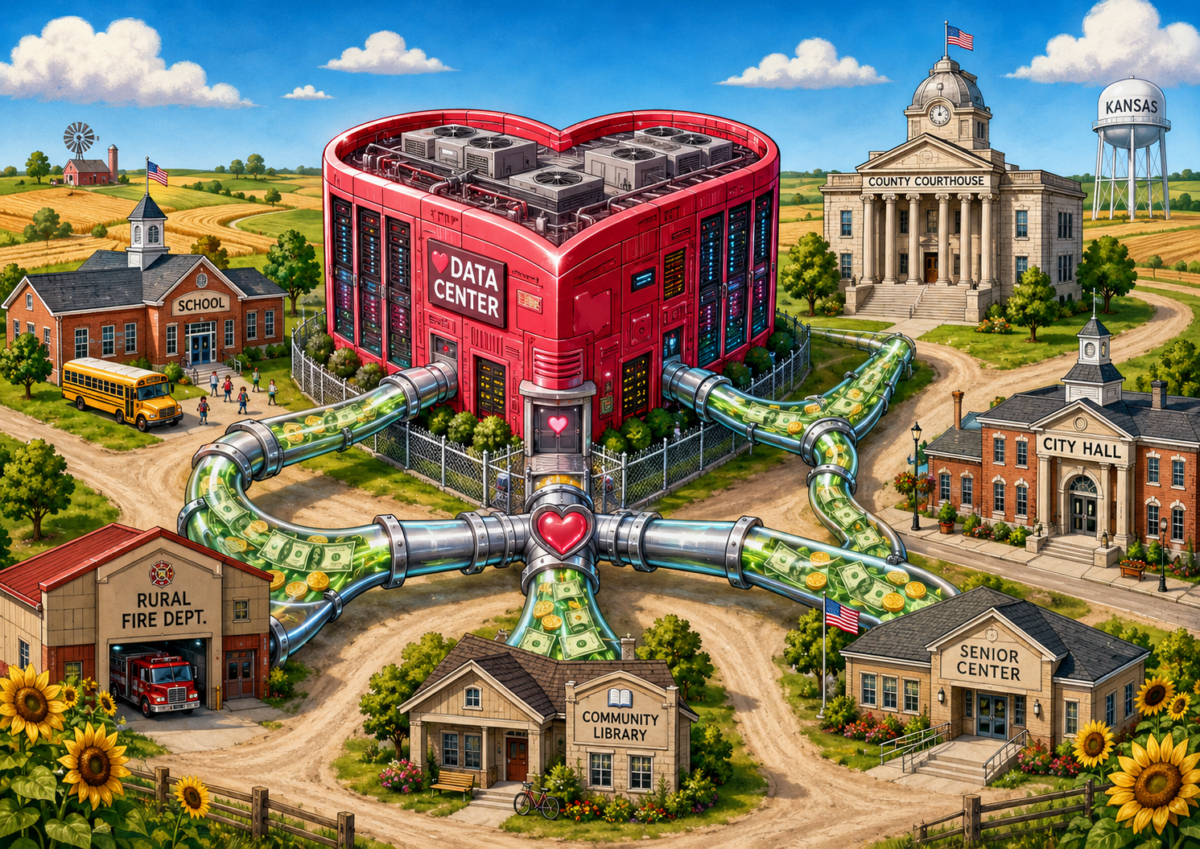
A major data center can change that equation. These facilities can add enormous value to the local property tax base without requiring the same level of public services as a large residential subdivision. They do not fill classrooms with hundreds of new students. They do not create major crime problems. They do not tear up county roads like some heavier industries. Properly negotiated, they can help pay for schools, roads, fire protection and infrastructure while easing pressure on residential property owners and agricultural landowners.

That doesn’t mean communities should be naïve. Local officials should ask hard questions about water, power, transmission lines, tax abatements, emergency response, noise, land use and long-term obligations. Agreements should protect taxpayers. Utilities should be honest about capacity. Companies should pay their way. But getting important answers is very different from the “stop it before it starts” attitude that seems to be growing across the state.
And the national security issue should galvanize conservatives to favor these facilities. The AI race isn’t just about convenience apps or corporate profits. It is about economic power, military capability, cyber defense, intelligence gathering, medicine, energy and global influence. If the U.S. slows its own AI infrastructure while the CHICOMs accelerate their own, we can’t pretend there will be no consequences.
The Chinese Communist Party has no values of free speech, individual liberty, private enterprise or limited government. A world in which the CHICOMS dominate artificial intelligence is a world in which authoritarian surveillance, censorship and state-controlled technology gain power. Letting China win the AI race would be a strategic blunder of historic proportions.
We have to see that rural Kansas isn’t left out of the next great industrial transformation. We have land. We have workers. We have communities that need tax base expansion. We have every reason to insist on fair deals — and every reason to reject fear-driven obstruction.
The future is going to require data centers. The only question is whether Kansas and rural America will help build that future and benefit from it, or stand aside while someone else does.