

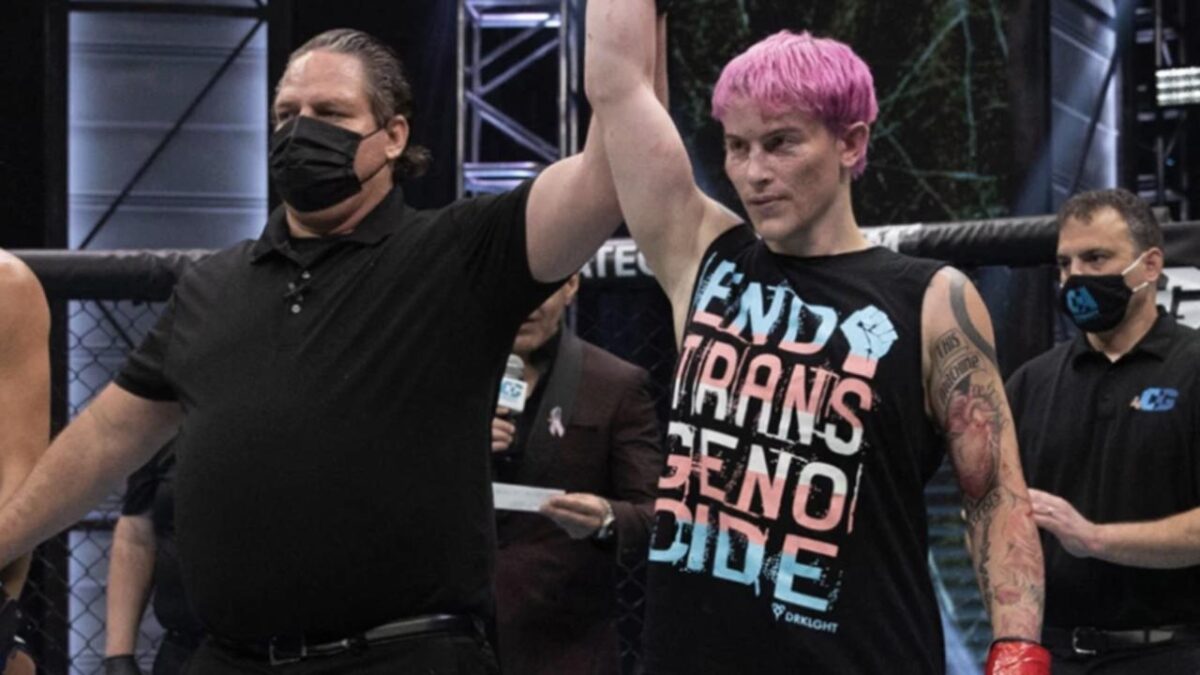
Trans MMA fighter Alana McLaughlin wins his debut fight in Australia in 2021/news.com.au
WASHINGTON, D.C. — Kansas Rep. Sharice Davids joined 129 other congressional Democrats who signed up in opposition to Title IX protections of women’s sports as part of Tuesday’s major U.S. Supreme Court hearing on the issue.
Davids, who previously voted against the Protection of Women and Girls in Sports Act in 2023, is among 119 congressmen and 11 Senators – all Democrats – who signed an amicus curiae brief urging the high court to strike down state-level laws banning men in women’s sports. Two of those state laws are now under review by the court.
Kansas passed its “Fairness in Women’s Sports Act” in 2023, a law banning men from participating in women’s sports at the high school and college level, after legislators overrode a veto by Democrat Governor Laura Kelly.

SCOTUS on Tuesday heard arguments in Hecox v. Idaho and West Virginia v. B.P.J., two cases challenging laws that bar men and boys from competing on female sports teams. Lower courts blocked both state bans, and Idaho and West Virginia are appealing.
Davids did not issue a public statement specific to Tuesday’s hearing, but her position aligns with her previous votes. In April 2023, Davids opposed H.R. 734, the Protection of Women and Girls in Sports Act, which sought to define Title IX sex protections strictly by biological sex at birth and restrict sports participation accordingly. That bill passed the House but stalled in the Senate.
At the time, Davids said decisions about student participation should largely remain with parents, educators, and local school districts rather than being determined through federal mandates. Her vote drew criticism from advocacy groups arguing that such restrictions were necessary for athletic fairness and safety of women who are typically at a physical disadvantage to men.
Davids is a former Mixed Martial Arts athlete who fought in the women’s division as an amateur in 2006 and fought as a professional in 2013 and 2014. Davids has refused to say in answer to media questions in regard to her votes on the issue whether she would have been willing to fight a man during her MMA career.
Her era in the sport had its own controversies involving male-born competitors. Illinois fighter Fallon Fox, fighting in the women’s division, fractured his opponent Tamikka Brents’ skull in a 2014 fight, leading to debates about fairness and regulations for trans athletes in combat sports. Brents at the time described her defeat:
“I’ve fought a lot of women and have never felt the strength that I felt in a fight as I did that night,” she told MMA webstie cagepotato.com. “I can’t answer whether it’s because she was born a man or not because I’m not a doctor. I can only say, I’ve never felt so overpowered ever in my life and I am an abnormally strong female in my own right. Her grip was different, I could usually move around in the clinch against other females but couldn’t move at all in Fox’s clinch.”
This incident, along with others like former male-born Army Special Forces soldier Alana McLaughlin’s professional debut in 2021, sparked intense scrutiny and discussions within the MMA community and regulatory bodies.
The 130-member congressional brief filed with the Supreme Court reflects a murky interpretation of Title IX that appears to contradict the law’s original aim. Organized by Democratic leaders including Rep. Becca Balint and Rep. Teresa Leger Fernández, the brief argues that state bans actually violate Title IX and the Equal Protection Clause of the Fourteenth Amendment. It asserts that exclusions based on biological sex – a founding principle of Title IX – harm transgender students by stigmatizing them and creating barriers to participation in school activities. It also maintains enforcement of bans could subject girls to invasive scrutiny of their genitals to determine sex.
Proponents of the bans filed competing briefs arguing that physical advantages associated with male puberty can affect fairness in competitive female athletics and that states have legitimate authority to protect women’s and girls’ sports categories. Idaho and West Virginia argued that without categorical bans, state athletic associations face confusion, litigation exposure, and disputes over competitive equity.
The Supreme Court’s ruling, expected later this year, is likely to have sweeping national implications. Depending on the outcome, the Court could either affirm states’ authority to impose categorical bans or determine that such prohibitions violate federal anti-discrimination law, setting a uniform national standard.
Davids’ participation in the amicus brief signals her continued alignment with the Democratic caucus to oppose traditional Title IX protections for women—a position she has consistently maintained during her tenure. Davids’ office has not yet replied to an email seeking the congresswoman’s comments on Tuesday’s hearing.
SCOTUS is expected to render a decision in the issue by this summer.