

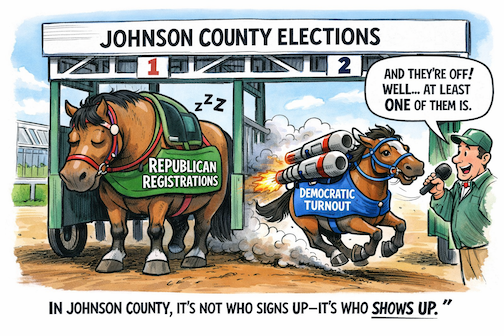
The “bluing” of Johnson County election results in recent years comes down less to numbers than it does to who tries hardest.
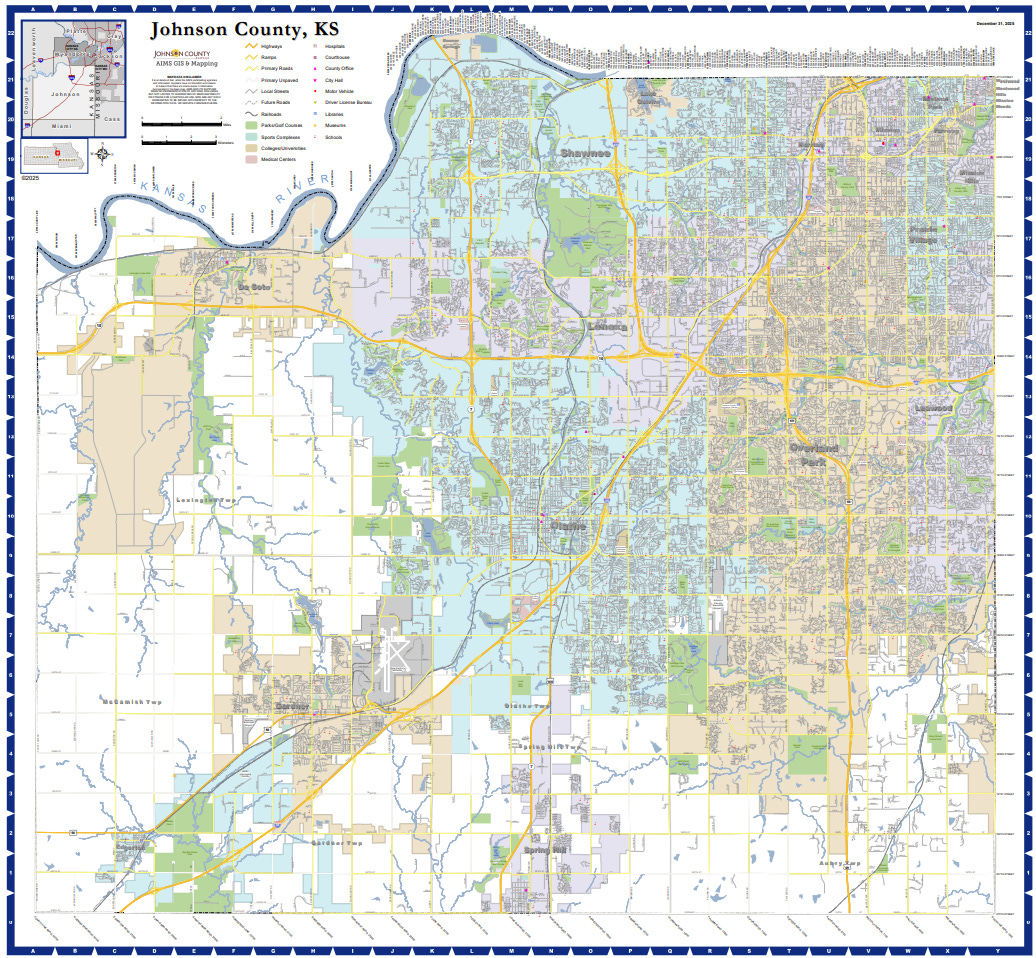
That’s the conclusion of a detailed analysis of voter registration and turnout patterns across the county’s 26 governmental jurisdictions by Olathe-based data scientist Earl Glynn, who compiled and published the voter data on his Watchdog Lab Substack. Glynn’s dissection of registration, population and demographic data shows telling differences between cities and townships; between registered and actual voters, and between male and female participation.
“This county is not monolithic,” Glynn said. “When you drill down into the precincts, you see deep diversity in political identity and turnout behavior.”
Registration: Republicans Lead, But Not Evenly
Glynn’s analysis of Johnson County’s registration breakdown shows:
- 40% Republican
- 32% Democratic
- 28% Unaffiliated/Other
But city-level differences are stark:
| Largest GOP Shares | Largest Democratic Shares | Highest Unaffiliated Shares |
|---|---|---|
| Lake Quivira 57% | Westwood 49% | Edgerton 32% |
| Mission Hills 51% | Roeland Park 45% | Merriam 31% |
| All 7 townships 51–59% GOP | Westwood Hills 42%, Fairway 40% | Gardner Twp. 30% |
Smaller groups include Libertarians at 1% (5,513 voters), “No Labels” 0.31% (1,424 voters) and United Kansas: 0.04% (173 voters).
“These smaller parties are too small to swing a jurisdiction alone,” Glynn noted, “but they tell us the county has more ideological diversity than most think.”
Turnout: Democrats Significantly Overperform
But it’s in voter turnout in the Sunflower State’s ecomomic juggernaut that Democrats significantly overperform. While Democrats represent 31.66% of all registered voters, they accounted for 45.37% of the actual voting population in 2025 — a 13.7-point overperformance.
Republicans, by contrast, saw turnout only 2 points above their registration share. Unaffiliated and third-party voters underperformed by 15 points. Overall turnout was about 25%, but by party:
| Party | Turnout |
|---|---|
| Democratic | 36% |
| Republican | 26% |
| Unaffiliated/Other | Far below county average |
“Democratic voters had a turnout machine behind them,” Glynn said. “Republicans had the registration advantage in many places, but Democrats had the turnout advantage — and that’s what wins elections.”
Prairie Village: A Turnout Case Study
Prairie Village stood out with some of the county’s highest turnout. The number show 54% of Democrats voted compared to 51% of Republicans. Despite Republican registration advantages in Ward 5, GOP candidates lost both races in that ward.
Glynn said the data strongly suggests gender played a role.
“Republican women didn’t vote like Republican men,” Glynn said. “In several Prairie Village precincts, women’s participation surged, and their candidate choices broke from party registration patterns.”
Two precincts — 5-2 and 5-3 — showed the sharpest gender-driven divergence.
Gender: Women Drive Elections
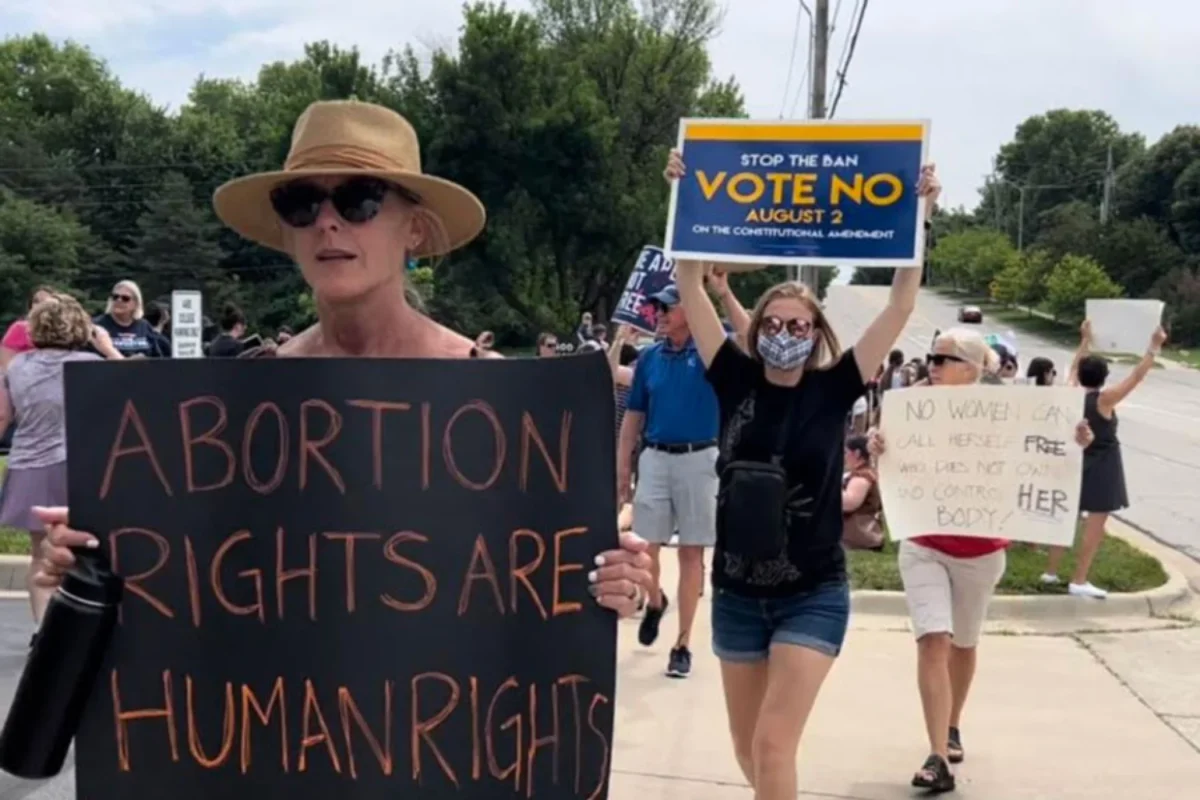
Though census estimates show more men than women under age 65 in Johnson County, the reverse is true in the voter rolls. The number show 23,000 more female registered voters than males. Women were 2% more represented in the 2025 voting population, and men were 2% underrepresented
In some areas, the gap was dramatic:
| Jurisdiction | Female Overrepresentation | Male Underrepresentation |
|---|---|---|
| Westwood Hills | +4.6% | –4% |
| McCamish Twp. | +7.5% | –7.5% |
“No voter-registration advocacy group seems concerned about the underrepresentation of men,” Glynn observed.
School Districts: Turnout Favors Democrats
Across the county’s eight major school districts (USD 229 Blue Valley) the GOP leads in registrations, but Democrats turned out at +10% higher rate. USD 233 Olathe saw the same pattern: Republican registration advantage, Democratic turnout dominance. Glynn said these turnout patterns mirror the November city elections and help explain Democratic wins in “nonpartisan” races.
Why Democrats Win in a ‘Red’ County
Though Republicans still hold a larger share of registered voters in many cities and all townships, the data shows Democrats win key races because they turn out more consistently. That’s especially true in suburban cities like Prairie Village, Fairway, Westwood, and Roeland Park. According to Glynn, the reason is strategic.
“The decades-old Mainstream Coalition and its modern extension, The Voter Network, have built a sophisticated relational-organizing system. It’s ‘peer pressure with a purpose,’ and they’re very good at it.”
Glynn estimates that progressive groups have invested more than $3 million building the turnout infrastructure now driving Democratic overperformance in local elections. The dynamic has obvious impact in the county’s biggest statewide race – the 3rd Congressional District – where Democrat Sharice Davids is now serving her fourth consecutive term.
“There is no equivalent effort on the right,” Glynn said.