
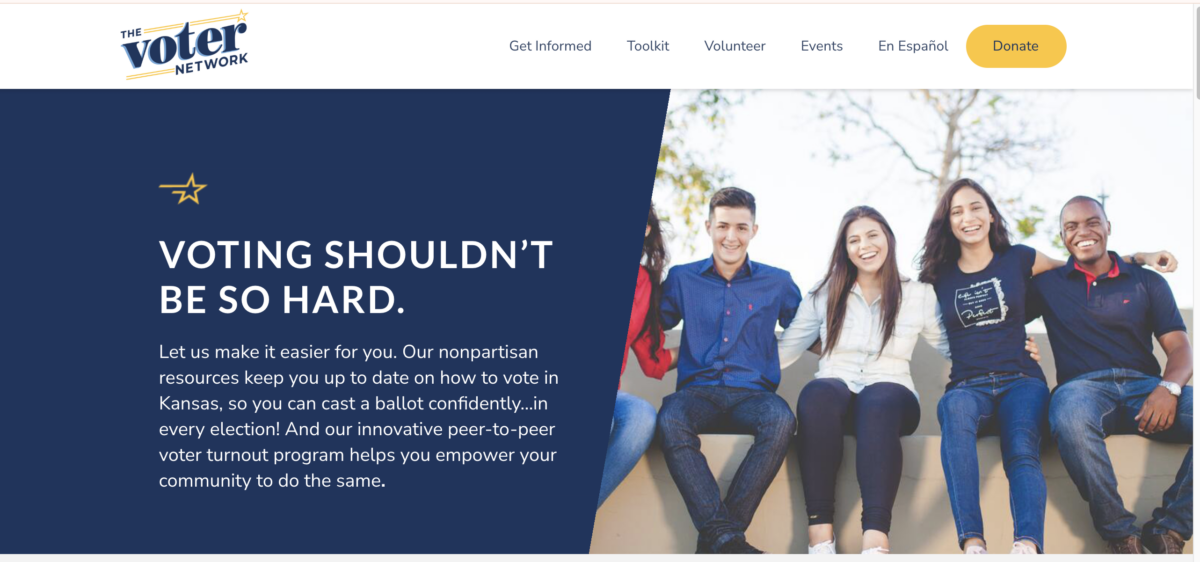
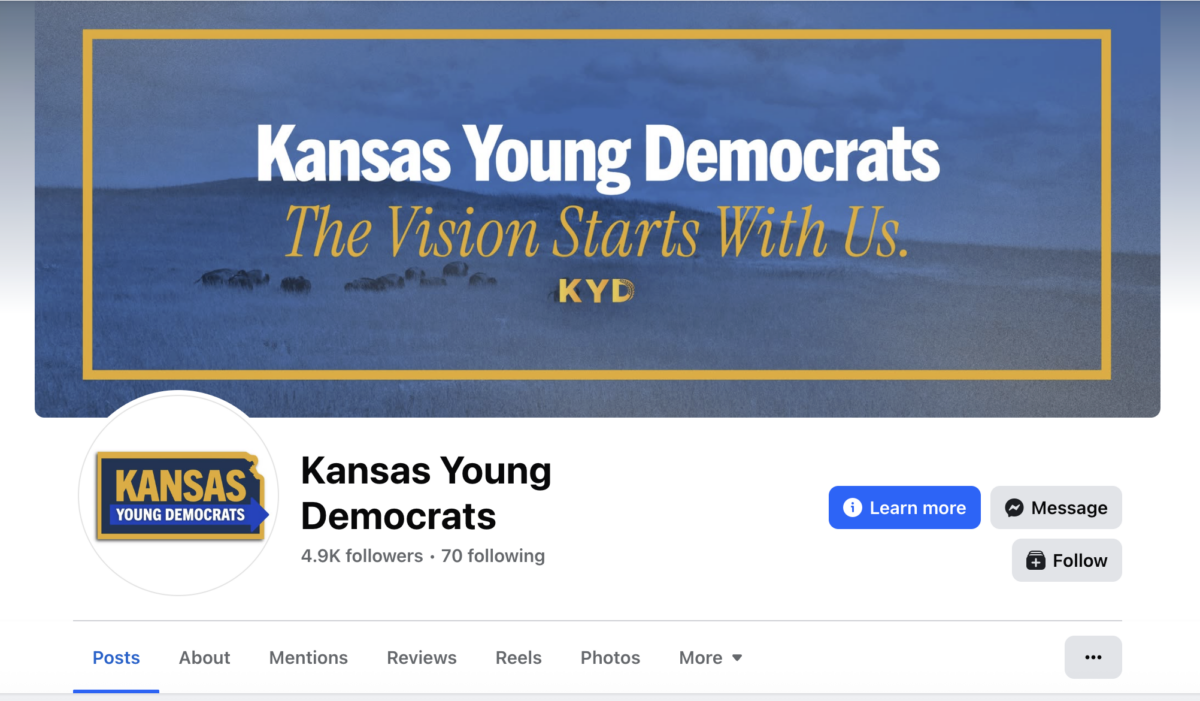
By law, tax-exempt 501c3 organizations can’t meddle in politics. But questions are being raised about whether the self-described “non-partisan” nonprofit “The Voter Network” is staying within federal tax law after documents show it plans to partner with the partisan Kansas Young Democrats political action committee to mobilize student voters ahead of the 2026 election.
Tax-exempt 501c3 organizations can’t support or oppose a candidate for public office, or coordinate with political parties or Political Action Committees on campaigns, make lobbying a substantial part of their activities or engage in campaign intervention of any kind. But according to a 2026 Strategic Plan circulated by the Kansas Young Democrats PAC, the group plans to counter conservative organizing on Kansas college campuses through a partnership with The Voter Network, which operates a voter mobilization platform known as Voter-to-Voter.
“At issue is not whether a PAC can engage in voter mobilization,” said Earl F. Glynn, a Kansas data analyst who has closely tracked nonprofit election activity, and whose Watchdog Labs Substack monitors those groups. “The question is whether a 501(c)(3) nonprofit can lawfully provide its tools and infrastructure to support that partisan effort.”
Strategic plan details partnership
The Kansas Young Democrats’ plan calls for a statewide “relational organizing” effort, encouraging individuals to mobilize people within their own social networks to vote.
“By utilizing their proven ‘Voter-to-Voter’ tool, we will empower young Kansans to mobilize their own social circles to get out the vote,” the PAC’s plan states.
The document also says the PAC “could offer” $500 stipends to “Young Dem Mobilizers” who successfully turn out the highest number of voters using the platform. Verification would be based on whether identified “low-propensity” voters ultimately cast ballots in the 2026 election.
“That language is what raises the red flag,” Glynn said. “When turnout verification and stipends are tied directly to a partisan PAC’s goals, it moves well beyond generic civic engagement.”
Background on The Voter Network
The Voter Network was formed in 2019 as part of the Mainstream Coalition, based in Merriam, and became an independent nonprofit in early 2023. In 2024, it was designated an “emerging” state partner of State Voices, a national network of advocacy and organizing groups.
State Voices has received nearly $5 million from Open Society Foundations between 2016 and 2023, along with grants from several nonprofit funds managed by Arabella Advisors, according to publicly available grant records.
“The funding history matters because it shows the broader ecosystem these organizations operate in,” Glynn said. “That doesn’t make their work illegal—but it does make compliance boundaries especially important.”
Voter-to-Voter platform
The Voter-to-Voter system allows registered “ambassadors” to view public information on whether friends or contacts have voted in past elections and suggests outreach actions. The platform is designed to focus on so-called “low-propensity” voters—those who historically vote infrequently.
As of Sunday, the platform listed 603 teams and more than 2,200 ambassadors operating in Kansas—an increase of 178 teams since September 2025.
“In September 2025, at least one team could be traced to a political party,” Glynn said. “That suggests the system has already brushed up against partisan use.”
Legal and compliance concerns
Federal law prohibits 501(c)(3) organizations from participating in or intervening in political campaigns on behalf of, or in opposition to, any political party or candidate. While nonprofits may conduct non-partisan voter education and registration, they are barred from providing services that favor one political party.
“If The Voter Network allows a partisan PAC to use its system for targeted turnout operations, that’s a serious compliance question,” Glynn said. “A nonprofit in that position must be prepared to say ‘no,’ even if the request aligns with its ideological leanings.”
Glynn noted that The Voter Network has publicly invited complaints to the Internal Revenue Service if members of the public believe its activities violate federal law.
“That invitation suggests confidence,” he said, “but it also underscores the stakes.”
If a 501(c)(3) is believed to be engaging in prohibited political activity, the primary enforcement authority is the Internal Revenue Service. Federal law strictly bars 501(c)(3) organizations from endorsing or opposing political candidates, contributing to campaigns, or coordinating with political parties. Alleged violations can be reported to the IRS using Form 13909, the Tax-Exempt Organization Complaint (Referral). Complaints may be filed anonymously and should include specific details such as dates, descriptions of the activity, and any available documentation or public evidence. While the IRS does not disclose the outcome of complaints, credible referrals are reviewed and investigated.
In addition to federal oversight, complaints may also be filed with the state attorney general’s office, which oversees charitable organizations at the state level. This route is particularly relevant when concerns involve misuse of charitable funds, misleading donors, or violations of state charitable trust laws. In limited circumstances—such as when a nonprofit appears to be coordinating campaign expenditures or engaging in electioneering communications—a complaint may also be filed with the Federal Election Commission.
Not all political or policy-related activity by a 501(c)(3) is prohibited. Nonprofits may engage in nonpartisan voter education, issue advocacy, and limited legislative lobbying, provided such activity does not become a substantial part of their operations and does not favor or oppose specific candidates. The legal line is crossed, however, when charitable organizations use their resources, platforms, or staff to directly influence elections.
Claimed effectiveness
Supporters of relational organizing often cite turnout gains. A slide presentation published by the United Methodist Health Ministry Fund highlighted early Voter-to-Voter results from 2018 to 2020, showing significantly higher turnout among voters contacted through the system.
“The data clearly show the tool works,” Glynn said. “That’s precisely why the line between non-partisan civic engagement and partisan campaigning matters so much.” He saiud the issue ultimately comes down to governance and restraint.
“A PAC can be partisan—that’s its purpose,” he said. “A 501(c)(3) cannot. The unresolved question is whether The Voter Network will enforce that distinction when its tools are this powerful.”

Dane Hicks is a graduate of the University of Missouri School of Journalism and the United States Marine Corps Officer Candidate School at Quantico, VA. He is the author of novels "The Skinning Tree" and "A Whisper For Help." As publisher of the Anderson County Review in Garnett, KS., he is a recipient of the Kansas Press Association's Boyd Community Service Award as well as more than 60 awards for excellence in news, editorial and photography.