

WASHINGTON, D.C. – President Trump this week aggravated cattlemen by pledging to prompt new trade deals for foreign beef in view of high American beef prices, and late in the week moved to loosen federal meat-processing to give beef producers more ways to turn their cattle into marketable beef without depending on a handful of enormous packing companies.
Trump announced Friday, Aug. 28, that his administration was preparing legal action intended to give farmers and ranchers greater ability to process their own livestock and sell the meat, including potentially across state lines.
The beef deal with as yet undisclosed foreign countries – most likely Argentina – will likely be felt by American consumers quicker than cattlemen will benefit from expanded processing regulations. But beef producers in the states have wanted looser processing options – and more competition for their cattle among those buyers – for more than a decade.
The proposal could be particularly significant in Kansas. Kansas pastures and feedlots held 5.85 million cattle and calves at the beginning of 2026 — roughly twice the state’s human population — and ranked third nationally in total cattle inventory, according to the Kansas Livestock Association and USDA statistics. Kansas also processed about 5.9 million cattle commercially in 2025, second-most in the nation.
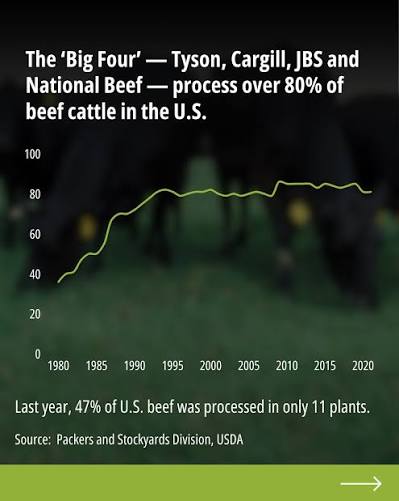
Yet much of that processing capacity is concentrated in the hands of the same huge companies Trump is now targeting. Reuters reports that Cargill, Tyson Foods, JBS USA and National Beef together control about 85 percent of U.S. beef processing. National Beef operates two of the nation’s largest plants at Dodge City and Liberal, while other major packers also operate large facilities in the Kansas cattle corridor.
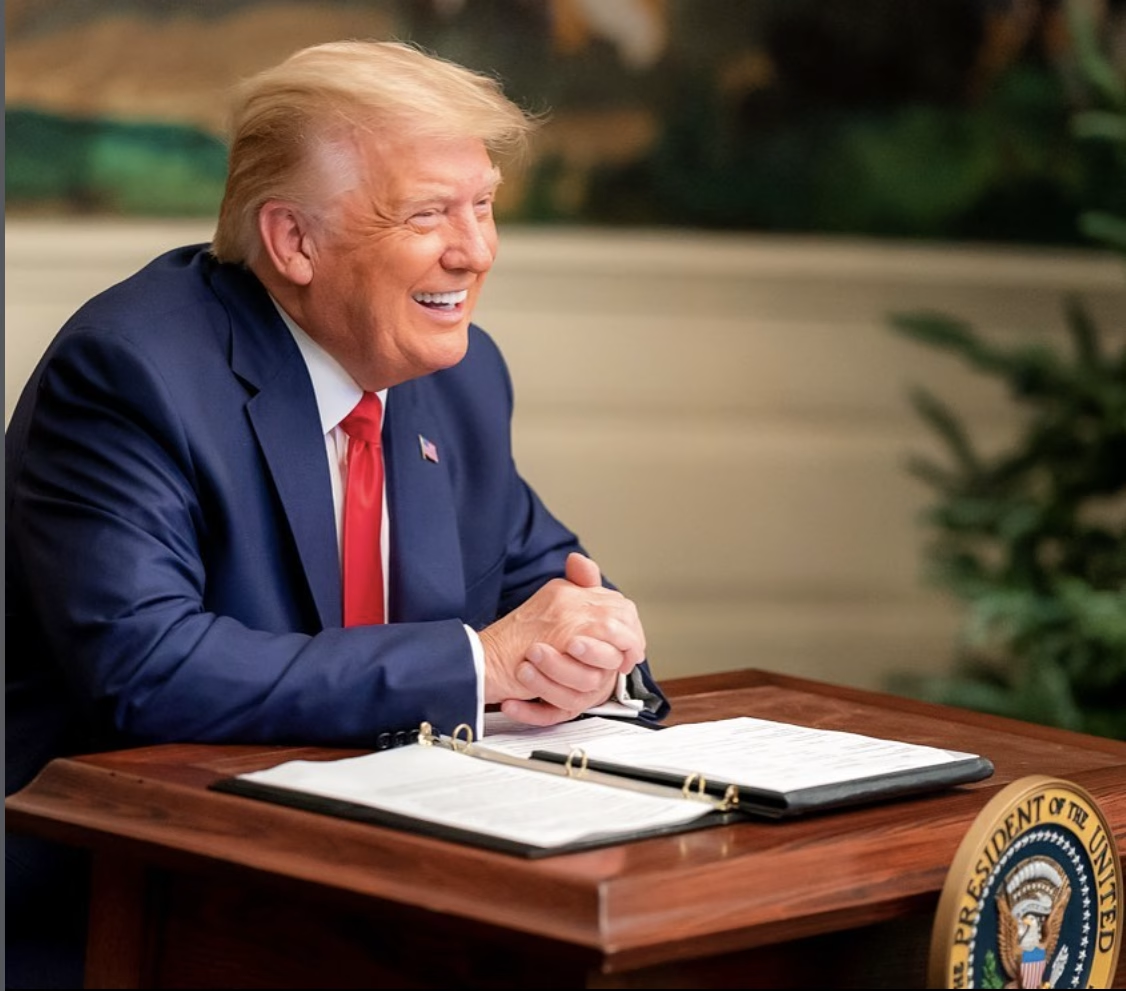
Trump described the current system as a “nasty monopoly” and said the large processors “make life miserable for our wonderful Farmers and Ranchers,” according to his Truth Social announcement quoted by NOTUS. The idea appeared to gain momentum during Trump’s Aug. 26 appearance on The Glenn Beck Program.
Beck, himself a ranch owner, interrupted a discussion of beef prices to urge Trump to examine what Beck called the “meat processing cartel.”
“I’m telling you, it is the processing plants,” Beck told Trump, according to a published transcript of the radio broadcast. Beck complained that federal rules make it extremely difficult for ranchers to butcher and market their own cattle.
“Help us. Help us,” Beck pleaded. Two days later Trump announced the administration was drawing up legal documents.
Agriculture Secretary Brooke Rollins said USDA announcements beginning Monday would include efforts to expand ranchers’ ability to sell across state lines, help smaller meat processors and rescind outdated federal guidance, Reuters reported.
Kansas producers know the value of owning more of the beef
Kansas has already shown an example of what can happen when cattle producers retain an interest farther down the processing chain. U.S. Premium Beef was created as a Kansas company by cattlemen in the 1990s to give producers market access, carcass information and an ownership stake in value-added processing. The producer organization subsequently bought an interest in National Beef.
Tracy Thomas of U.S. Premium Beef told Kansas State University earlier this year that producers originally identified three essentials: “market access, data, and ownership.”
The results have been substantial. K-State reported that U.S. Premium Beef producers received an average premium of only $8 per head during the organization’s first year. By 2025, the average premium exceeded $105 per head. Through 2025, producers had received approximately $953 million in premiums.
Trump’s plan won’t prompt every ranch to build a slaughterhouse. The potentially larger impact would come if the changes make it easier for local lockers, producer cooperatives and independent regional processors to expand, obtain inspection and sell beef beyond Kansas. Kansas currently allows state-inspected meat to be sold within Kansas, while USDA-inspected products can be sold across state lines. Kansas Department of Agriculture says its state inspection requirements must already “meet or exceed federal standards.”
Relaxing the interstate barrier while maintaining inspection could therefore be much more economically significant than simply allowing individual ranchers to butcher a few additional animals themselves.
USDA is already moving in that direction financially. Its new Strengthening Processing for U.S. Ranchers, or SPUR, program is making up to $500 million available to support small, independent and mid-sized beef slaughter facilities. The agency says the goal is to “preserve independent slaughter capacity” and maintain competition in the beef marketplace.
Would cattlemen get more money?
Potentially — if increased processing capacity creates more buyers competing for cattle.
That’s the economic issue behind the concentration argument. A rancher generally benefits when several buyers are bidding for his cattle. When only one or two practical buyers operate within economical hauling distance, the buyer has more leverage.
A 2026 study published in the American Journal of Agricultural Economics estimated that plants belonging to the four largest beef packers represented about 83 percent of fed-cattle processing capacity. The researchers also found that Kansas, Nebraska, Texas, Iowa and Colorado together contained 77 percent of the nation’s fed-cattle processing capacity.
More independent plants would not automatically guarantee higher cattle prices. But additional bidders — particularly regional processors purchasing locally — could strengthen competition.
Texas A&M agricultural economist David Anderson cautioned Reuters that small-scale on-farm slaughter by itself would not move the national market much.
“The numbers on that would be so small,” Anderson said. Industri analysts say that’s want makes the exact form of Trump’s forthcoming regulations critical.
Don’t expect cheap hamburger overnight
Consumers should also be wary of assuming deregulation will quickly return beef prices to old levels. The country simply does not have enough cattle. That’s true in Kansas too.
USDA figures show the state’s cattle and calf inventory has fallen from roughly 6.13 million head at the beginning of 2024 to 5.85 million at the beginning of 2026 — a decline of about 280,000 head, or nearly 5 percent, in just two years. Even more significant, Kansas’ beef cow herd — the breeding stock needed to produce future calves — fell from 1.23 million cows in January 2025 to about 1.145 million in January 2026, a decline of nearly 7 percent in a single year. That shrinking breeding herd helps explain why beef supplies cannot quickly respond to today’s record cattle prices.
USDA counted 86.2 million cattle and calves nationwide on Jan. 1, the smallest U.S. herd in roughly 75 years. Beef cows totaled 27.6 million, another 1 percent decline from the previous year.
Years of drought, high feed costs and herd liquidation helped create that shortage. AP reported this week that ground-beef prices have risen about 57 percent in five years and steak prices about 35 percent. Economists told AP rebuilding the herd will take years because cattle reproduction cannot respond quickly to higher prices.
Trump’ temporary solution to high beef prices was to foster competition in that market as well – soliciting an additional 300,000 metric tons — roughly 660 million pounds — of lower-tariff imported beef over a 90-day period. That move infuriated cattle organizations.
National Cattlemen’s Beef Association CEO Colin Woodall said “flooding the market with government-subsidized, below-market beef” was not the way to rebuild the American herd. American Farm Bureau Federation President Zippy Duvall similarly called the import expansion a “gut punch to ranchers’ bottom line.”
The contrast is important for Kansas.
Importing additional foreign beef may put downward pressure on cattle prices along with retail beef prices. Expanding American-owned and independent processing capacity, on the other hand, could increase competition for Kansas cattle while allowing ranchers and rural processors to capture a larger portion of the value between the pasture and the grocery counter. Whether Trump’s proposals ultimately benefit cattlemen and consumers will depend on what the legal documents actually say.