

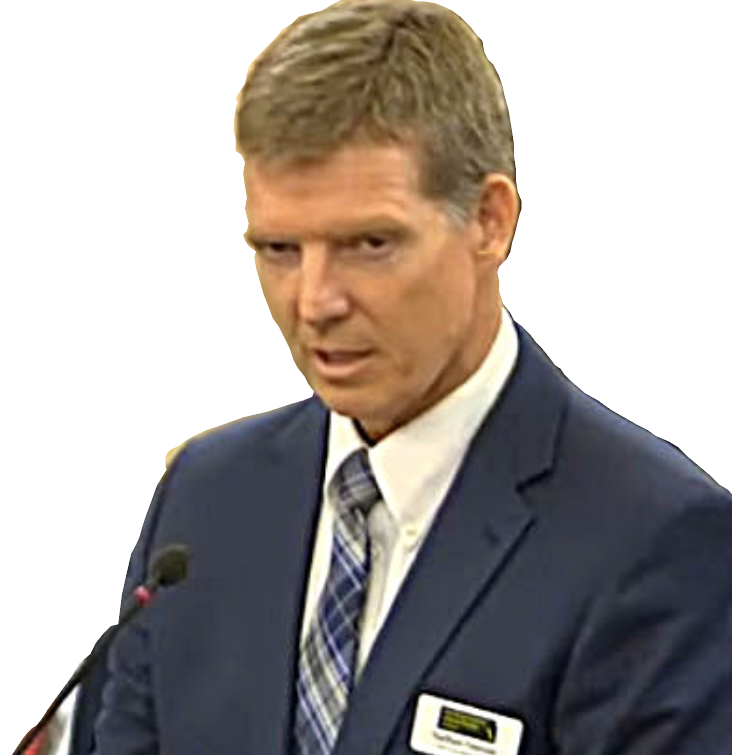
SEKMHC CEO Nathan Fawson testifies before a Kansas House committee in January.
IOLA – A meeting of the board of trustees of the Southeast Kansas Mental Health Center last night in Iola yielded no new information regarding the sudden dismissal of nearly two dozen center staff last week, the status of its suspended executive director and ongoing questions as to what “overpayments” may have resulted in the sudden financial stress.
Anderson County Commissioner Mike Blaufuss, appointed to one of the county’s two seats on the board after the six county commissions in the SEK district executed a full-scale reset of the board last fall, told the Informer most of the Tuesday meeting was conducted in closed session.
The agency announced layoffs, wage reductions, and a hard turn from its planned expansion into other healthcare offerings last week, after year-long blowback regarding spending decisions, as well as the failure of bureaucratic connections which would have captured more Medicaid revenue for its business acquisitions. But the release blamed the settling of overpayments – apparently made to SEK – as the reason for the layoffs.
A press release from the agency, which became locally emblematic the past year of broader criticism surrounding bloated executive salaries, said SEKMHC will terminate 23 employees by the end of the month and implement across-the-board salary reductions including cuts to executive pay. Those management pay levels brought a financial rebuke from county commissions after those figures became public a year ago. The organization is also separating from Ashley Clinic and Yates Center Dental, two major components of its recent expansion into integrated care. SEK sought a Federally Qualified Health Center designation for Ashley which as of this writing had not been approved. FQHC’s receive preferable federal reimbursement allowances from the Health Resources and Services Administration.
BEYOND MINNESOTA: THE CASE FOR STRONGER ANTI-FRAUD ENFORCEMENT
Comments by SEKMHC CEO Nathan Fawson to a Kansas legislative committee in January made it appear Ashley’s approval as a FQHC was in jeopardy, and Fawson told legislators if it was not approved SEK likely could not maintain ownership of Ashely. SEK has been tight-lipped regarding the impact of that
“These measures were necessary to stabilize the organization and ensure continuity of services,” the press release stated. Interim Executive Director Doug Wright declined comment for an article published in The Iola Register, directing all inquiries to the organization’s board attorney. The newspaper’s attempts to reach board leadership were unsuccessful. The Informer’s email to board attorney Jacob Bielenberg for this article went unanswered as well.
An internal memo reviewed by the Register indicates employees will see a 12% reduction in base wages, while Wright said he is taking an additional 17% pay cut on top of earlier reductions.
Meanwhile, CEO Nathan Fawson and CFO Job Springer have both been suspended, with Fawson having been placed on administrative leave in January. Their long-term status remains unclear. No details were released regarding Springer’s suspension. The cuts follow what SEKMHC described as a “retroactive rate adjustment for 2025” that resulted in overpayment for services, though no information was provided regarding from whom those overpayments were received, or who billed for what services.
Despite the current financial strain, SEKMHC’s tax filings show the organization has undergone explosive financial growth since becoming a Certified Community Behavioral Health Clinic (CCBHC) and accessing advanced levels of Medicaid reimbursement in recent years. Speaking to Anderson County Commissioners subsequent to public outcry over executive salary revelations last year, county SEK board appointee Dana Spencer said the CCBHC designation brought about “life changing money” to the organization through those increased Medicaid reimbursements.
Under the CCBHC model, clinics are reimbursed through an enhanced Medicaid payment structure designed to cover the full cost of delivering a comprehensive set of behavioral health services. Unlike traditional fee-for-service Medicaid billing—which pays providers per visit or procedure—CCBHCs receive a prospective payment system (PPS) rate, often calculated on a per-patient, per-day or per-visit basis, and intended to fully fund operations.
CALIFORNIA MAN PLEADS GUILTY TO $270M MEDICATION REIMBURSEMENT FRAUD SCHEME
That shift proved transformative for the organization, bringing about a staff expansion, industry-leading salaries for management and the acquisition of two private healthcare providers in Ashley and Yates Center Dental.
A review of SEKMHC’s IRS Form 990 filings shows total revenues—and particularly Medicaid-related income—rose sharply following certification. The model effectively unlocks significantly higher and more predictable reimbursement streams, allowing clinics to increase staffing, expand services, and pursue acquisitions such as Ashley and YCD.
The CCBHC framework also requires clinics to provide nine core services, including crisis care, outpatient mental health treatment, primary care screening, and substance use services—either directly or through formal partnerships. Kansas now has at least 25 such clinics operating under the model.
The influx of Medicaid dollars has not gone unnoticed, particularly since The Kansas Informer broke the executive pay story in March 2025. SEKMHC’s 2024 IRS Form 990 shows Fawson received $685,147 in salary and more than $203,000 in benefits. Combined compensation for top executives exceeded $2.1 million that year. Execs at SEK were the highest paid of any of Kansas’ 26 mental health districts.
Fawson has previously defended the pay increases, citing a 2021 compensation study conducted by a Phoenix-based consulting firm that recommended significant adjustments in order to hire qualified staff to execute SEK’s expanding mission. Its board of trustees approved those consultant recommendations. Fawson was suspended only days after he testified before the Kansas House Committee on Health and Human Services last January.

Still, the rapid growth in revenue—fueled largely by Medicaid reimbursements under the CCBHC model—has drawn scrutiny from local officials.
County commissions across SEKMHC’s six-county service area have taken the unusual step of replacing nearly all of their board representatives over the past year. Allen County commissioners cited “numerous complaints” about executive compensation when removing their appointees in 2025.
At the same time, counties have dramatically reduced their financial support. Once contributing more than a half million annually, local governments now provide virtually no funding, with several counties contributing just $1 as a statement opposing SEK’s executive largesse.
SEKMHC’s aggressive growth strategy was closely tied to the expanded revenue made possible under CCBHC certification. The acquisition of Ashley Clinic brought surgical and primary care services into the organization’s orbit, while partnerships helped launch facilities such as the Cubs Community Care Center in Humboldt, supported in part by a $5 million grant involving USD 258 and Allen Community College.
But that expansion is now being scaled back. Earlier this year, surgery-based services tied to Ashley Clinic were transitioned out of SEKMHC, and officials acknowledged ongoing discussions with Neosho Memorial Regional Medical Center about preserving access to care in the region. Those negotiations have not fruited a partnership, however.
The latest announcement severs ties with both Ashley and YCD, signaling a retreat from the integrated care model that once defined the organization’s growth strategy.
Even as SEKMHC moves to cut costs and stabilize operations, key questions remain unanswered regarding the overpayments referenced in Wright’s press release – how much money has to be paid back, and how the overpayments occurred. For now, SEKMHC says no additional cuts are planned and that mental health services will continue without interruption.
The contrast between years of surging Medicaid-funded revenue and today’s emergency cost-cutting measures is likely to keep the organization—and the CCBHC model itself—under close public scrutiny, particularly in view with national allegations of Medicaid fraud in Minnesota and California.